When we were starting to practice playing badminton, we sometimes play outdoors! Really! Not a good idea right? [due to differense in pressure that produces a relatively horizontal movement of air called wind! B-) ] But it turns out to be positive because we were able to meet someone in our plaza who knows about badminton. He even explained to us how experts buy shuttlecocks.
So, to deepen our knowledge, here are more facts about shuttlecocks:
Material Used In Shuttlecock:
Shuttle is made of either natural or synthetic material. Feathered shuttle is natural while plastic shuttle is synthetic. Playing characteristics of both shuttles are different.
* Feathered shuttle are brittle and more prone to damage. It need to be replaced several times during a game. That's why shuttles made of synthetic materials like plastic are frequently used these days. But feathered shuttlecocks can be controlled easily so experienced players prefer feathered shuttle over plastic ones.
* Plastic shuttles are very durable and last many matches without any impairment to the flight. Plastic shuttles can be hit hardly.
A Standard Shuttle
A standard shuttle is made by following the guidelines given by International Badminton Federation.
* The feathers shall have a uniform length between 62mm to 70mm, when measured from tip to the bottom. The feathers shall be firmly fastened with thread or any suitable material.
* The tip of feathers should lie on a circle of diameter between 58mm to 68mm.
* The shuttle shall weight from 4.74gm to 5.50gm.
Do you know?
The best Badminton Shuttlecocks are made from feathers from the left wing of a goose
.
SOURCE
Showing posts with label shuttlecock. Show all posts
Showing posts with label shuttlecock. Show all posts
Tuesday, October 20, 2009

Monday, October 19, 2009
Shuttlecock Part 1
We just buy our shuttlecocks from...well, from no particular place. We could even find cheap shuttlecocks in terms of price for around Php10 (around US$0.20) B-) ...but when we have learned the benefits of a good-quality shuttlecock, we now try to search for the best specs of a shuttlecock.
Here are some specs of a shuttlecock:
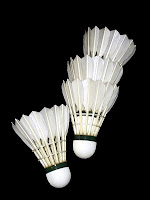 A shuttlecock weighs around 4.75 - 5.50 grams. It has 14-16 feathers with each feather 70mm in length. The diameter of the cork is 25-28mm and the diameter of the circle that the feathers make is around 54mm.
A shuttlecock (often abbreviated to shuttle and also commonly known as a bird) is a high-drag projectile, with an open conical shape: the cone is formed from sixteen overlapping feathers embedded into a rounded cork base. The cork is covered with thin leather or synthetic material.
Synthetic shuttles are often used by recreational players to reduce their costs as feathered shuttles break easily. These nylon shuttles may be constructed with either natural cork or synthetic foam base, and a plastic skirt.
Additionally, nylon shuttlecocks come in three varieties, each variety for a different range of temperatures. These three varieties are known as green (slow speed which will give you an extra 40% hang time/shot length), blue (middle speed), and red (fast speed). The colours, and therefore speeds, are indicated by coloured strips fastened around the cork. In colder temperatures, a faster shuttle is used, and in hotter climates, a slower one is chosen.
Also, a slow speed shuttlecock is usually used in area that are in higher elevation. It is also used by coaches to train strength of stroke and for building stamina (longer rally) to train muscles on the arms.
source
Here are some specs of a shuttlecock:
 A shuttlecock weighs around 4.75 - 5.50 grams. It has 14-16 feathers with each feather 70mm in length. The diameter of the cork is 25-28mm and the diameter of the circle that the feathers make is around 54mm.
A shuttlecock (often abbreviated to shuttle and also commonly known as a bird) is a high-drag projectile, with an open conical shape: the cone is formed from sixteen overlapping feathers embedded into a rounded cork base. The cork is covered with thin leather or synthetic material.
Synthetic shuttles are often used by recreational players to reduce their costs as feathered shuttles break easily. These nylon shuttles may be constructed with either natural cork or synthetic foam base, and a plastic skirt.
Additionally, nylon shuttlecocks come in three varieties, each variety for a different range of temperatures. These three varieties are known as green (slow speed which will give you an extra 40% hang time/shot length), blue (middle speed), and red (fast speed). The colours, and therefore speeds, are indicated by coloured strips fastened around the cork. In colder temperatures, a faster shuttle is used, and in hotter climates, a slower one is chosen.
Also, a slow speed shuttlecock is usually used in area that are in higher elevation. It is also used by coaches to train strength of stroke and for building stamina (longer rally) to train muscles on the arms.
source
Subscribe to:
Posts (Atom)
